Sustainability Management
The requirements for manufacturing companies to determine sustainability KPIs are increasing. As part of sustainability reporting, the information that companies have to publish is being extended beyond the usual economic aspects to include ecological and social aspects. The aim is to identify emission reduction potential in order to derive suitable improvement measures. The focus is on the energy and material consumption of the company’s own production plants as well as on the entire value chain. Examples of KPIs for determining the ecological footprint are:
- greenhouse gas emissions, e.g. CO2 emissions
- water and land use
- energy consumption
- waste volumes
- recycling rates
In addition to direct emissions from the company’s own production processes (Scope 1), emissions from purchased energy (Scope 2) and emissions from upstream and downstream value chains (Scope 3) must be taken into account. The basis for this are the German and European supply chain laws.
In its “Recommendation on the use of common methods to measure and communicate the life cycle environmental performance of products and organisations”, the EU Commission describes the principles for the analysis:
- completeness of material and energy flows
- consistency and comparability of the methods used
- high accuracy to minimise uncertainties in modelling the product system and in reporting results
- transparency and traceability of KPI calculations
The process industry faces particular challenges here, as production and value chains do not run sequentially, either within a plant (gate-to-gate) or across sites (cradle-to-gate), but are highly meshed and include recycle streams.
We support you in a systematic and extensible implementation of sustainability KPI calculations based on a model of the relevant balance boundaries and value chains. Influencing factors can be integrated gradually and traceably for Scope 1, Scope 2 and Scope 3. For this purpose, we offer a powerful “integration layer” for importing data from third-party systems (e.g. meters, PLCs or SAP), from reports (e.g. Excel-based reports) or from commercial emission databases. With our “calculation layer”, emission factors can be combined with production quantities, for example, to determine the required sustainability KPIs.
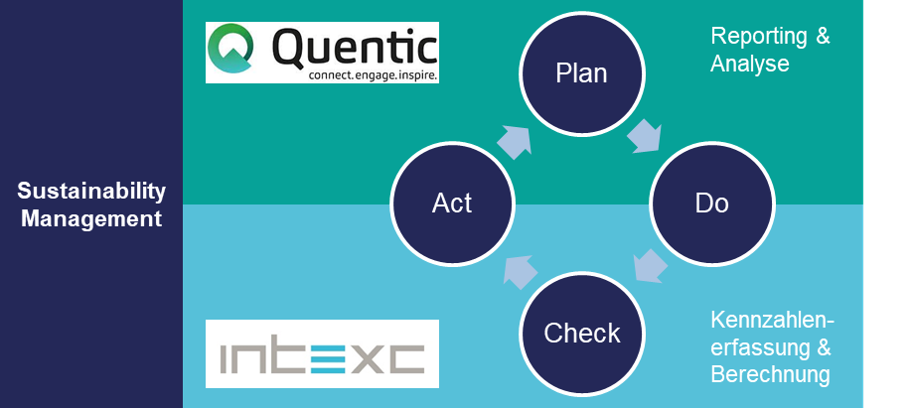
In cooperation with Quentic, one of the leading providers of HSEQ and ESG management solutions in Europe, we offer a complete solution for sustainability management according to the ISO-compliant plan-do-check-act process.
Please feel free to contact us.